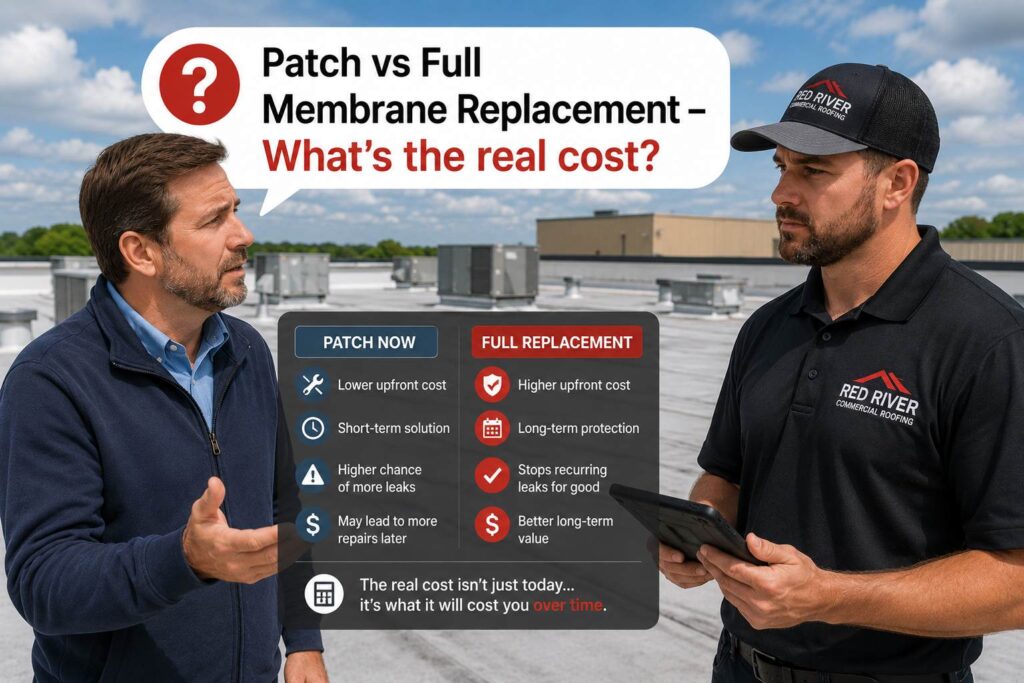
This is one of the most practical questions a business owner can ask, and it’s also one of the most misunderstood. A lot of owners assume the choice comes down to “cheap and fast” versus “expensive and slow,” and pick based on whatever their budget looks like that quarter. The reality is more nuanced, and making the wrong call in either direction can end up costing significantly more than the roof itself.
Here’s how the numbers, and the timelines, actually break down.
Patch Repair: The Real Cost Picture
A localized patch repair, sealing a seam, fixing a puncture, replacing a section of flashing, is the cheapest option in the short term, and for the right situation, it’s the correct one. Most patch repairs on commercial roofs in the OKC metro range from a few hundred dollars for a minor, isolated fix up to several thousand for a larger repair involving multiple problem areas or specialized materials.
The timeline is short too. A straightforward patch repair, once a contractor is on site, is often completed the same day. Even a more involved repair covering several problem spots across the roof typically wraps up within a day or two.
That’s the appeal, and it’s a real one. But the cost picture only tells half the story if the roof isn’t actually a good candidate for repair.
Where patch repair costs go up unexpectedly:
- If moisture has already gotten into the insulation, a “simple” patch job can turn into cutting out and replacing wet insulation before the membrane repair even starts.
- If the same roof needs repeat visits because the underlying membrane is too degraded to hold a lasting patch, those service calls add up fast, and you can end up spending close to replacement cost over a couple of years without ever getting a roof that stops leaking.
- Emergency or after-hours repair calls, common here during storm season, typically cost more than a scheduled repair would.
Full Membrane Replacement: The Real Cost Picture
A full replacement is a bigger number up front, and I won’t pretend otherwise. Commercial roof replacement costs vary widely depending on square footage, the roofing system chosen, the condition of the insulation and decking underneath, and whether code upgrades are required, but it’s reasonable to expect a cost in the tens of thousands of dollars for a small commercial building, scaling well into six figures for larger facilities.
What that number buys you, though, is a full reset: new membrane, new insulation where needed, new flashing details, and typically a fresh manufacturer warranty covering the entire system for the next 15 to 30 years depending on the material chosen. You’re not just buying a roof, you’re buying a known quantity for the next couple of decades instead of an aging system that requires ongoing guesswork.
Where replacement costs can be managed:
- Scheduling outside of peak storm season often means more competitive contractor pricing and faster scheduling.
- Getting a written scope of work, not just a total price, from multiple contractors lets you compare accurately instead of comparing incomplete numbers.
- Some replacements can be phased in sections for larger facilities, spreading cost across budget periods without leaving the whole roof exposed during the transition.
The Timeline Difference Is Bigger Than Most Owners Expect
This is the part that catches business owners off guard. A patch repair might be done in an afternoon. A full commercial roof replacement is a different scale of project entirely.
From permit to completed installation, a commercial roof replacement in Oklahoma often takes closer to five months, considerably longer than in states like Colorado, where similar projects average around two months. That gap is largely driven by contractor demand, especially in the stretch of time following our spring hail season, when every roofing company in the metro is booked out handling storm damage across the region.
That timeline has real implications for planning:
- If you wait until a roof is actively failing to start the replacement process, you could be looking at months of active leaks, temporary patches, and operational disruption while waiting for your project to reach the front of the queue.
- If you start the process proactively, based on inspection findings rather than an emergency, you have far more control over scheduling, contractor selection, and minimizing disruption to your business.
- Storm season timing matters. Getting ahead of hail season, which runs mid-April through mid-May here, means you’re not competing with every other storm-damaged building in the metro for the same crews and materials.
How to Actually Decide
I walk clients through a simple framework rather than defaulting to either option:
- Is the roof under two-thirds of its expected lifespan, with clean moisture readings and localized damage? Repair is almost always the right call, and the cost and timeline advantages are real.
- Is the roof in the back half of its expected lifespan, with recurring repair calls or widespread issues showing up during inspection? This is where repair starts costing you more over time than it saves, and the smarter move is to start budgeting and scheduling replacement on your terms, not the roof’s.
- Is there significant moisture already in the insulation? If more than roughly a quarter of the insulation is saturated, patching the surface won’t solve the underlying problem, and you’re likely looking at replacement regardless of the membrane’s remaining life.
The Bottom Line
Patch repair wins on cost and speed for a roof that’s still fundamentally sound with isolated damage. Full replacement costs more up front and takes months rather than days, but it resets the clock and gives you a warrantied system built to handle what Oklahoma weather throws at it for the next couple of decades. The expensive mistake isn’t choosing either option. It’s choosing repair on a roof that actually needs replacement, and finding that out one leak at a time over several storm seasons instead of making the call proactively with real inspection data in hand.
If you’re not sure which category your roof falls into, that’s exactly what a full inspection with moisture testing is for. It turns this decision from a guess into a number you can actually budget around.