Lake Hefner and the Memorial Road Corridor (NW OKC)
Weather pattern: This stretch of the metro sits in open, largely unobstructed terrain, with Lake Hefner adding a wide expanse of water with nothing to break wind speed before it reaches the surrounding neighborhoods and commercial corridor. Storms tracking through NW OKC tend to pick up and hold speed as they move across the lake, and the area regularly sees higher sustained wind speeds and stronger wind-driven rain and hail than more built-up parts of the metro. Straight-line wind events and severe thunderstorm wind gusts are a recurring concern here, in addition to the hail risk shared across the whole metro.
Homeowner and property owner concerns:
- Wind uplift at roof edges and ridge lines, since wind exposure here is consistently higher than in more sheltered neighborhoods
- Whether shingles or membrane systems are properly rated and fastened for higher sustained wind speeds, not just standard code minimums
- Hail hitting at sharper angles due to wind shear, which is more pronounced in open, lake-adjacent areas
- Fence, siding, and rooftop equipment damage happening alongside roof damage during the same wind events, which owners often notice first and use as a signal to check the roof
- Homes and buildings closer to the lakeshore asking specifically whether their roofing system is adequate for their exposure level, compared to a similar property a few miles inland
What This Actually Means for Commercial Buildings in the Corridor
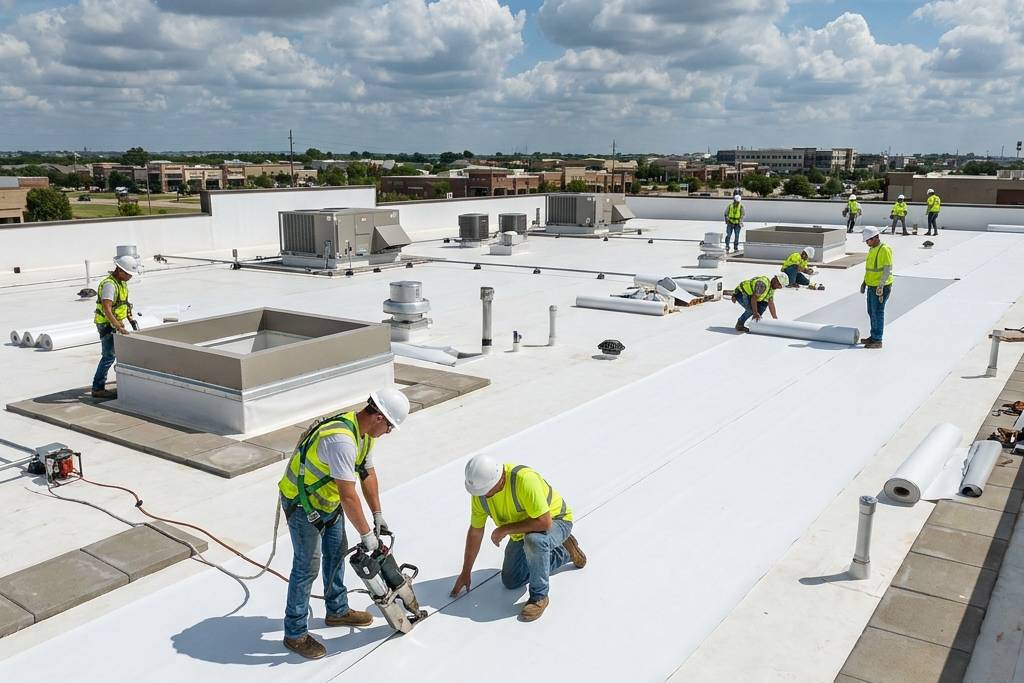
Memorial Road between Lake Hefner and the surrounding retail and office development is one of the densest commercial corridors in NW OKC, banks, medical offices, retail strips, restaurants, self-storage facilities, and office parks, nearly all of them built with flat or low-slope membrane roofs. That building type interacts with lake wind exposure in a few specific ways that a sloped residential roof simply doesn’t experience the same way.
Wind uplift on flat membrane systems is the primary risk here, more than punctures. On a flat roof, wind doesn’t just push, it creates pressure differentials at the roof edges, corners, and parapet walls that actively try to lift the membrane away from the deck. In more sheltered parts of the metro, this is a manageable, code-standard concern. Along the Memorial Road corridor, with essentially open exposure back toward the lake and few large structures or tree lines to break wind speed before it hits a building, that uplift force is consistently higher. The failure points I see most often on commercial roofs out here are:
- Perimeter and corner membrane detachment, where fastening patterns that would hold fine on a more sheltered building start to fail because the actual wind load the roof experiences exceeds what a standard fastening spec accounts for
- Parapet wall flashing pulling loose, since parapets catch wind pressure directly and are a common starting point for a wind event that then works its way into the field of the roof
- Rooftop unit curbs and equipment anchoring loosening over time, not necessarily failing in one event, but working loose incrementally across repeated high-wind days until a bigger storm finishes the job
- Membrane billowing and fatigue even without full detachment, where repeated wind loading flexes the membrane over insulation in a way that accelerates wear at seams long before any visible tear appears
Hail impact compounds on top of this, and the angle matters. Because wind shear is more pronounced in this open corridor, hail here tends to strike membrane surfaces at a sharper angle rather than falling straight down. On a flat commercial roof, that angled impact concentrates force differently than it would on a sloped residential roof, often striking the vertical face of curbs, parapets, and rooftop equipment housings in addition to the horizontal membrane surface. I look at both when I’m inspecting a building along this corridor after a storm, not just the flat field of the roof.
What this means practically for a business owner in this specific area:
- Fastening patterns and wind uplift ratings matter more here than the code minimum used elsewhere in the metro. If your building sits within a mile or two of the lake or along the open stretch of Memorial Road, it’s worth asking your roofing contractor whether your system was specified for standard exposure or for the higher wind exposure this corridor actually sees.
- Post-storm inspections should specifically include parapet flashing and rooftop equipment anchoring, not just a scan of the membrane field, since that’s where wind-related failures tend to start in this area.
- Buildings here often show cumulative wind fatigue before they show a single dramatic failure. A membrane that looks intact after one storm may already have loosened fastening or stressed seams that make it more vulnerable in the next one, which is why an annual inspection matters even in years without a major named storm.
- Owners considering re-roofing a building in this corridor should ask specifically about wind uplift rated systems and enhanced perimeter fastening, rather than defaulting to whatever spec a contractor would use for a more sheltered part of the metro.