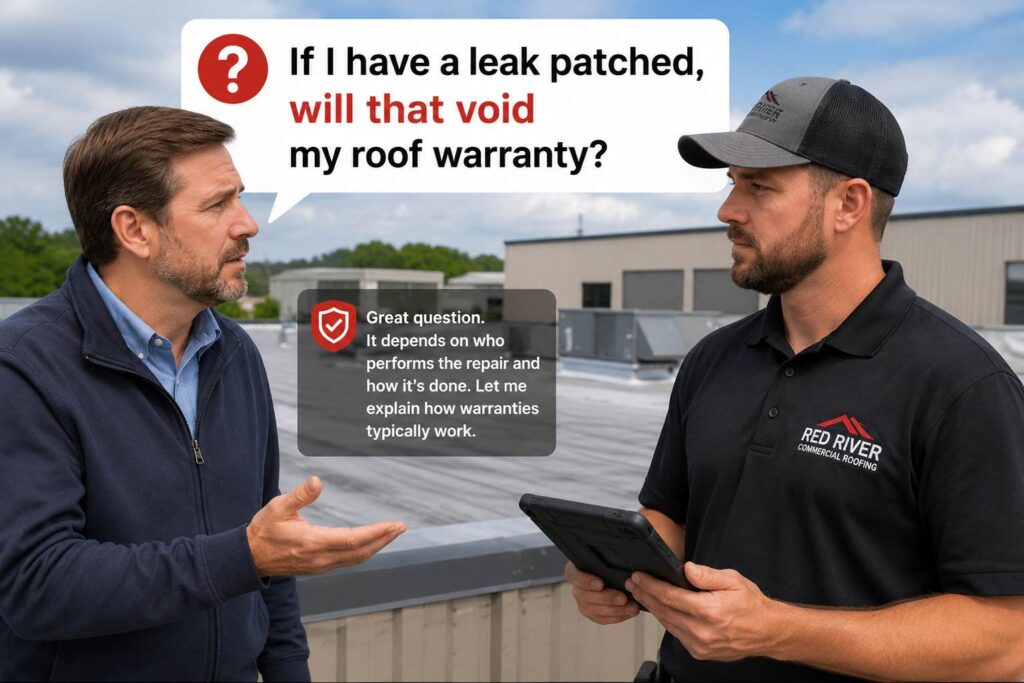
Short answer: almost certainly yes, and it’s one of the most expensive mistakes I see business owners make. A DIY patch job, even a well-intentioned one done carefully, is one of the fastest ways to void a commercial roof warranty that might otherwise have years of coverage left on it. I understand the instinct. A leak shows up, it’s raining, and grabbing a tube of roofing sealant from the hardware store feels like the responsible thing to do. But before you climb up there with a caulk gun, it’s worth understanding exactly what you’re putting at risk.
Why Manufacturers Are So Strict About This
Commercial roofing warranties, whether they’re on a TPO, EPDM, PVC, or modified bitumen system, aren’t simple product guarantees. They’re performance warranties tied to a specific, documented installation and maintenance process. Manufacturers like GAF, Firestone, Carlisle, and others put a lot of engineering into how their systems are supposed to be repaired, right down to the specific primers, adhesives, and patching materials that are compatible with that exact membrane.
When an unauthorized repair goes onto the roof, whether that’s a homeowner-grade sealant, the wrong type of patch material, or even the right material applied incorrectly, a few things happen from the manufacturer’s perspective:
- The repair may not be chemically compatible with the membrane, which can actually cause the material around the patch to degrade faster than if nothing had been done at all.
- There’s no documentation that the repair meets the manufacturer’s installation standards, which most warranties require for any coverage to remain valid.
- The warranty language itself often specifically excludes damage resulting from unauthorized repairs or alterations performed by anyone other than a certified or approved contractor.
- It becomes difficult to prove root cause if the roof fails again later. Manufacturers and their inspectors need to be able to trace a failure back to a material or installation defect, not a patch job that introduces its own unknown variables.
In practice, this means a single DIY patch, even in one small corner of a much larger roof, can be grounds for a manufacturer to deny a claim on a completely unrelated section of the same roof down the line. Warranties are often evaluated on the system as a whole, not just the specific spot that was patched.
What This Looks Like in the Real World
I’ve walked onto commercial roofs in the OKC metro where a maintenance crew, a well-meaning employee, or even a previous contractor slapped a patch on an active leak during a storm. It stopped the immediate problem, which is understandable. But when it came time to file a warranty claim later for an unrelated issue, or when the manufacturer’s own inspector came out to evaluate a larger repair, that patch became the reason coverage was denied. The cost of the original leak ended up being a fraction of what the business owner paid for the roof section that was no longer under warranty.
This is especially relevant here in Oklahoma, where hail and wind damage are a near-annual event. If your roof takes a hit during a spring storm and you patch it yourself to stop water intrusion before a professional can get out, you may be solving today’s problem while creating a much bigger one for your next storm-related claim.
Who’s Actually Authorized to Repair Your Roof
Most manufacturer warranties require repairs to be performed by a contractor who is specifically certified or approved by that manufacturer for that particular roofing system. This isn’t just about skill level. Certified contractors have access to manufacturer-approved materials, follow documented repair procedures, and, in many cases, submit repair documentation directly to the manufacturer to keep the warranty’s paper trail intact.
If you’re not sure whether your current roofing contractor holds this certification for your specific system, that’s worth confirming before anything else, ideally before you ever have an active leak to deal with.
What to Actually Do When You Have an Active Leak
I know that “wait for a certified contractor” isn’t always realistic when water is actively coming into your building. Here’s the approach I recommend:
- Contain the interior damage first. Move equipment and inventory, place buckets or tarps to catch water, and protect what’s inside the building. This isn’t a roof repair and won’t affect your warranty.
- Document everything. Photos and video of the leak, the interior damage, and the date and time it started. This protects you whether you end up filing an insurance claim, a warranty claim, or both.
- Call a certified roofing contractor, not a handyman or general contractor, even for what seems like a temporary fix. Many roofing companies offer emergency response specifically because they understand how time-sensitive active leaks are.
- Avoid climbing up and applying sealant, tar, or patch material yourself, even temporarily. If a certified contractor genuinely can’t get there in time and the situation is urgent, ask them directly what temporary measures, if any, won’t jeopardize your warranty.
- Keep your warranty documentation accessible. Know what system you have, when it was installed, and who installed it, so you’re not scrambling to find that information during an active leak.
The Bottom Line
A manufacturer warranty on a commercial roof is one of the most valuable protections you have, especially in a market like ours where storm damage is a matter of when, not if. A DIY patch might feel like the responsible, cost-saving move in the moment, but it can quietly strip away coverage that would otherwise be worth far more than the repair itself. When a leak shows up, protect what’s inside your building, document what you’re seeing, and get a certified contractor on the roof before any repair material does. It’s the difference between a covered claim and an expensive lesson.